Hello, my dearest audiences! Welcome back. I left it at the primitives last time. The whole blog today is devoted to the TARDIS crews. Yes, they do deserve this much attention.
The structure of classic Doctor Who companionship
The Doctor
Ian and Barbara
Susan
The Structure of classic Doctor Who companionship
This is definitely the highlight of An Unearthly Child. As an introductory story, An Unearthly Child does not only introduce a typical political situation that would be used over and over again. Another structure to be introduced here is the structure of classic Doctor Who companionships.
In classic Doctor Who, the Doctor usually travels with at most three companions and at least one. There is often one or two female companions alongside a male companion. The male companion is the pillar of the physical strength of the whole group. Ian and Barbara with the First Doctor are one of my favourite combinations of TARDIS crews. The other one is Jamie and the Second Doctor.
Classic Doctor Who could afford to have three companion due to their overall long length of serials. In the revived series, every serial is shorter. There is not enough engagement for three companions. As classic Doctor Who evolved, the role of the male companion was gradually replaced by the Doctor himself. That is why from the Third Doctor and on, he travels with only a female companion most frequently.
The Doctor, an antagonist
William Hartnell is extremely outstanding. He left a remarkably strong impression through his superb acting to the audience in his first ten minutes. One of the traits of the First Doctor is his sheer arrogance. His rich facial expressions, evil smiles and laughter were particularly memorable. The First Doctor possessed strange oddness as well as egocentricity in his early days.
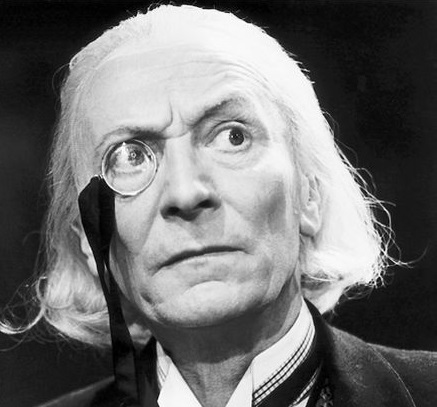
https://commons.wikimedia.org/wiki/File:William-Hartnell-crop.jpg
It is not completely unexplainable. Him being a time lord must have contributed a lot to this. You can imagine the pride of being a member of the most advanced race (to his mind) in the universe. Everyone else seemed inferior in comparison. There are different sources of arrogance, but in this case, his superiority. He thinks of human in the same way as to how we think of a mosquito, talking a bit harshly and being a bit more private are not any big deals.
The exploitation of this egocentricity made him partially an antagonist (but not a villain) from the perspective of Ian and Barbara.
There are two scenes in which the Doctor showed his capability of being an antagonist.
The first scene is in An Unearthly Child when he first confronts Ian and Barbara. It asserts the qualities which we have discussed above about the Doctor. The second one is in “The Forest of Fear”, he hideously attempts to kill Za who is wounded at that moment in order to get away. This scene exposed a little-known side of the Doctor.
Is it rationality? Yes, the Doctor is mostly rational (definitely so in this scene). Is he cold-bloodied? No…and yes, depends on from whose angle.
Let’s think about the whole situation from the Doctor‘s point of view. There are at least two good reasons why he should kill Za. First of all, under certain circumstances, the boundary of ethics is blurry and stretched. Why not sacrifice one to save four (assuming they will all die if they fail to escape)? Ethically speaking, the Doctor was a follower of utilitarianism. Whether utilitarianism is correct in moral dilemmas can’t be judged lightly, so let’s leave that to the ethicists. Secondly, it is a guiltless thing to do. Za is inferior to him. Killing a mosquito is not unethical to most of us, is it (many of us even do it on a daily basis)? Perhaps, this analogy is speciesist. However, being speciesist does not bother an immense group of people. Why should it bother the Doctor? From some dialogues later in this series, we see that his rationality is his ethics. Speciesism certainly is not one of his concerns.
The “yes” is from Ian and Barbara’s perspective. We shall talk about the “yes” later.
The takeaway here is that this scene provided us with an intriguing contrast between his successors or even himself later. Coldness seems to be washed away as time progresses (well, time doesn’t progress at all to the Doctor… does it?). I recall instantly, in “A Holiday for the Doctor ” which is the first episode of “The Gunfighters”, the First Doctor stated very clearly “I certainly disapprove of violence.”
Ian and Barbara, the human companions
To be fair, William Russell and Jacqueline Hill‘s acting is excellent. Not on the same level as William Hartnell’s, but quite close. Comparing to Carol Ann Ford, their performance seemed more natural. I will address that issue a little later. They are somewhat special as a pair of companions. Most of the companions travel with the Doctor by their choice, however, Ian and Barbara are forced (by the Doctor!) to do so. At the end of season one, they can be regarded as round characters. Nevertheless, I don’t think it is the right moment to discuss their roundness yet.
Other than being the first and two great companions, what else is significant about Ian and Barbara?
Here is one that is easily neglected. Why do companions travel with the Doctor? More specifically, whatever for are they in the show? Other than adding complexities to the story, they are also in an irreplaceable position throughout the series. For us, audiences, they provide a link to the contemporary earth. This link makes them more real and likeable for the audience. We resonate with those who are like us. Ian and Barbara as the first pair of companions had the duty of establishing this link. From what I have seen, they are perfectly ordinary and can be related by the majority of viewers. Susan and the Doctor are both unearthly in contrast to Ian or Barbara, therefore, lack relatability.
An example can help us gain more insight. Let us go back to the scene in which the Doctor tried to kill Za. Ian and Barbara found utilitarianism under that scenario unacceptable as many of us. The “yes” is based on a basic human moral code. Humans are driven by their sense of fairness and their instinct. There is not much more than that.
A large number of key changes which made the Doctor more like human are caused by his companions. One of such is his morality as we have discussed.
Susan, a screamer
Susan Foreman, the Doctor’s granddaughter, on the other hand, is very different from the Doctor. Her presence in An Unearthly Child is a necessity. Susan’s role is a bond between the TARDIS crews. Ian and Barbara meet the Doctor because of her; the Doctor needs to stay in the jungle when Za is wounded because of her. She is the glue that holds the crews, being the centre of the four-people-relationship.
Depicts as an enigmatic youngster in the first episode, Susan certainly lives up to the standard set by other regulars in that episode. Then, her performance turns into a rollercoaster and stops being consistent. As I have compared before, her acting is not natural somehow.
Ann is a competent actress, no doubt. Surely you have noticed too, Susan the character, produces “high-frequency sound waves” more…frequently than any other characters. I want to stress on the “more” here. I hate to say it, but the recurring screams are irritating and unbearable.
“Doesn’t the unpleasant sound annoy the viewers? Why should Susan lost her mystique associated with her curious behaviour and turn into a “screaming kid”?” You might be asking. This is indeed curious. One possible explanation is that Susan is a girl. Gender stereotype used to harass the integrity of some female characters in classic Doctor Who. If it is the stereotype, then there isn’t more to talk about.
The point I am trying to make here is that screaming itself is not aggravating. People scream when something triggers their inborn fear. It is completely normal. Abuse of this act is what caused the aggravation. Using screams properly can intensify a work. How could BBC have used it correctly on Susan then?
I will not provide anything specific, only the general principle. In my humble opinion, first and most importantly, we have to figure out the reason for a scream. Screaming for no or lame reasons looks extremely silly. (For instance, gender stereotype is an absurd reason.)
Secondly, building up enough tension is essential preparation for screams. When a character screams, it is a signal for the viewer that something utmost terrifying is happening. From the standpoint of the tension of a plot, screaming are peaks. Tension is released afterwards. This whole cycle must be planned beforehand to fit the storyline.
Finally, the amount of screams needs to be controlled. For any viewer, a scream consumes copious attention. Constant repetition of it is abysmally tiresome and ought to be avoided.
To sum it up, the TARDIS crews are nearly flawless. Everything works despite Susan’s screams. For the beginning of Doctor Who, An Unearthly Child brought the four people to live with much depth to each one of them. Thank you for your attention today! Next time we are going to take a look at some miscellaneous aspects of An Unearthly Child.
 Doctor Who Experience
