Hello, dear audience! Last time we talked about the plot of ‘the Daleks’. We analysed why it was well written. Surely you have noticed that many elements of the plot are related to the characters. Today, I will dissect the characterisation of the Dalek and notable individuals of Thal. Prior to Marco Polo, the fourth story in this season, the relationship of the Tardis crew member is a constant theme as well. Before we begin, you can find the link to the video of this story on the resources page of our website as always. Here we go!
The Daleks
Officially, our seven-parter at hand is known as the Daleks, in spite of the fact that each episode had different names. The reason that it is now known as ‘the Daleks’, not ‘the Thals’ or ‘Skaro’ etc. is possibly due to the recurrence of ‘the Daleks’ as the villain.
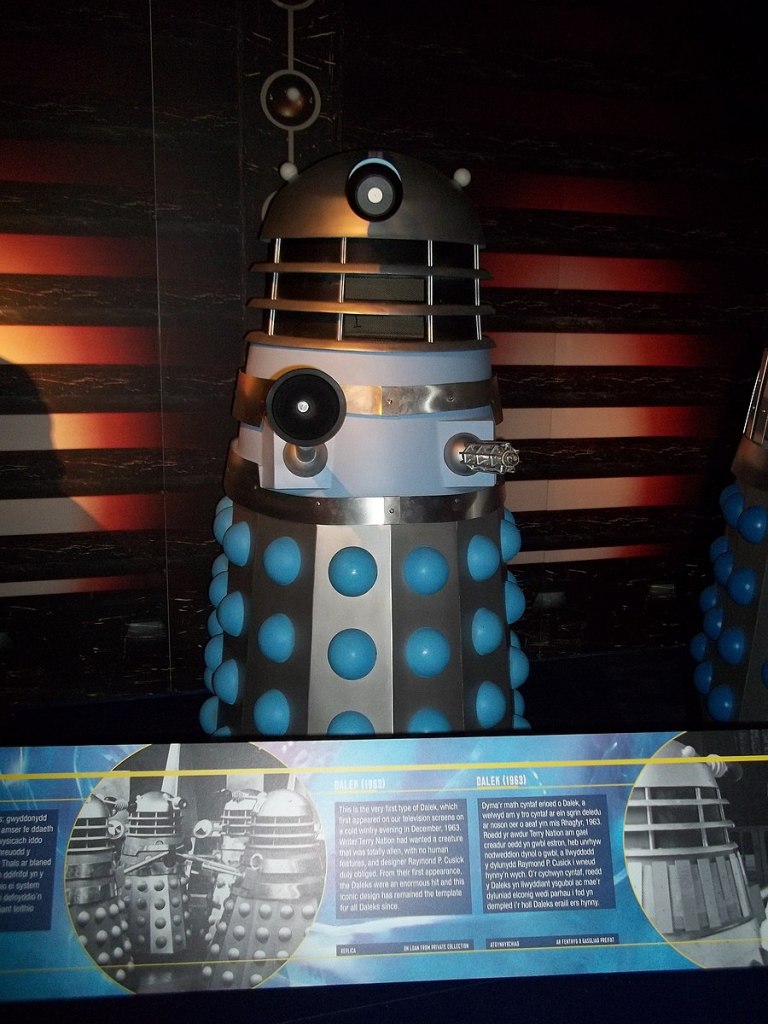
https://commons.wikimedia.org/wiki/File:Doctor_Who_Experience_Cardiff_-Rise_and_evolution_of_the_Daleks(14602025621).jpg
There are two points I want to take a look in depth here. The first is, what traits do the Daleks possess? Then, can they be qualified as villains in this story?
I want to start with a dialogue of the Daleks.
DALEK 2: We could let this catastrophe destroy the Thals.
DALEK 1: Will they let themselves starve to death? No. I feel preserving our prisoners was a good idea.
DALEK 2: And an arrangement to bring the Thals inside our city an even better one. DALEK 1: We’ll let our prisoners sleep and then give them food. After that, we can plan. DALEK 2: Why not begin now?
DALEK 1: Because the lapse of time, the relaxation of sleep, the provision of food, all these things will give them a false sense of security.
The Daleks are cunning and manipulative. The last line gave me a good shiver about the Daleks. First, they want to make the Thals believe the Daleks mean no harm. Later, we see them pretend to be nice, bring food and water to the TARDIS crews. In the same episode, they chose Susan to execute their plan. My guess is that Susan has a relatively young mentality, therefore, can be manipulated easily. Susan would not be as aware as other members of the intention of the Daleks. In addition to being manipulative, they are also ruthless. The Daleks want the anti-radiation drugs for themselves. Realising there is only enough for one side, they said they would let the Tardis members die without any consideration. If there was a little compassion in them, the Daleks would at least hesitate. These qualities of the Daleks are well demonstrated utilising dialogues.
Let’s move on to the second point. Are the Daleks villain yet?
We now recognise the Daleks as the nemesis of the Doctor. But the nice thing about words like nemesis is that it has a relative frame of reference. We can conclude “the Daleks are the nemesis of the Doctor” wholly by observing their relationship. The trouble of reaching a conclusion like “the Daleks are villains” is described as follows. To consider a character villain, labelling he as evil will be a key step. This is a large portion of the Daleks I have left out so far. Once we have found out the motivations behind the Daleks, it would be easier to give a verdict.
I generalised the motivation behind the Daleks’ actions into two types. One based on self-survival while the other is based on hatred to life that is not a Dalek. Conquest of other planets is not yet on their agenda. There is difficulty in distinguishing which is present at the moment or is it both.
Here are the things they intend to or have done. Dumping radiation and obtain the anti-radiation drug (they did not know it does not work for them) are acts done to survive. Ambushing the Thals originate from their hatred of other life forms. Most of their motivations are related to self-survival in this serial. To conclude this question, I do not think they deserve the title of a villain yet. It looks like they are more of a sinister antagonist than a villain.
The Thals
The Daleks is a tale about the encounter of two races after a nuclear war. We have just discussed the more malicious race. The Thals’ peace ideology and their beautiful speeches are equally intriguing. Through the examination of notable individuals, we can see what the Thal society is like.
Temmosus is the symbol of their pacific minds. He gives speeches of what he conceives of the future of the Daleks and Thals. I have to admit it is touching. We saw an open-minded leader who despises war and suspicion. The moment when the Thals walk into the trap of the Daleks, suspense was all over the screen. The pacifism of the Thals and the hostility of the Daleks have a collision. It was like a piece of butter put onto a heated pot that is red hot. The butter gets melted instantly. I felt he is quite a pitiful person when he died in the ambush.
Antodus as I had said in my previous blog, dies tragically. He represents an instinct of fear and anxiety. Although he does not go to the extremity to betray his team, Antodus still symbolises the negative emotion suppressed in the Thals. All this probably comes from a society of high expectation. That might be why Ganatus would force him through things he does not like.
Ganatus is a little more complicated. He is a perfect person from the beginning. He is brave and knowledgable. The epitome of society. If he had no change and remained perfect, it would a rather flat character. Then his brother dies because of his insistence. The guilt adds to the complexity of his character, making him one of the two round Thal character.
Now, the last individual of the Thal race I would like to mention is Alydon. He is the other round character I mention. Alydon has been believing in peace before Ian devises a genius plan to convince him. A conflict in beliefs between the Thals and the Tardis crews happens. A short internal conflict which is like the projection of the said external conflict in Alydons heart began also. The resolution of the internal conflict is his change in belief. This little change in mind leads to a big impact on Skaro. The Daleks are defeated and Thals could live safely.
 Doctor Who Experience